At The Education Partnership, we have noticed a significant trend emerging over the past few years. During COVID, the workforce experienced a sharp decline in qualified applicants that has yet to rebound, with 32% of small businesses reporting job openings they can’t fill. Many businesses (particularly those in Southwestern PA) have felt the strain of persistent employee shortages firsthand. As a result, there has been a shift toward funding and prioritizing workforce development programs, with many national foundations investing in trades training.
But where does education fit into that picture? Where does education end and workforce development begin, and how do we draw a meaningful distinction between the two?
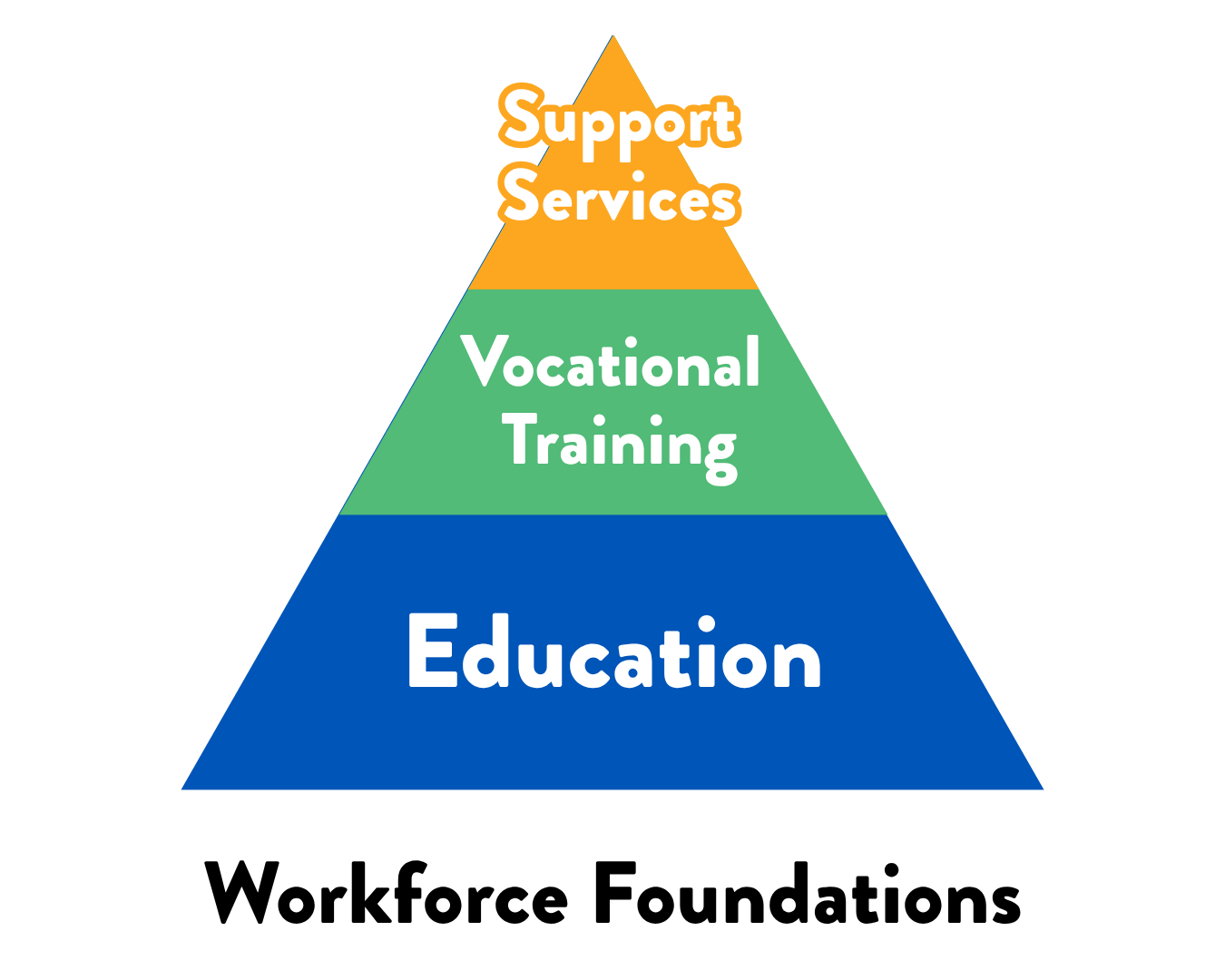 Education’s Fit into the Workforce Development Pyramid
A common misconception is that workforce development begins and ends with vocational training; if we simply invest more in trade skills and technical programs, we can solve the career shortages plaguing our communities. While vocational training is certainly important, it only addresses part of a much larger picture.
A truly strong workforce is built on three interconnected pillars: education, vocational training, and support services such as interview coaching and job placement resources. Each layer depends on the one beneath it, which is why it helps to think of workforce development as a pyramid.
At the base of that pyramid is foundational education, the learning that takes place during childhood. This stage is where the essential building blocks of a career are first established: arithmetic, reading and writing comprehension, fine motor skills, communication, collaboration, and more. These early skills are not just academic; they are the tools that young people carry throughout their professional lives.
From that foundation, individuals can advance into vocational training, where they develop the specialized skills needed to enter their chosen field, and ultimately connect with the employers who need them most.
Investing in PreK-12 Education is Investing in Workforce Development
When we at TEP examine the work our educators do with their students every day, we see something bigger than a classroom; we see a long-term investment in the future of Southwestern PA.
Research supports this view. A study published in the Journal of Vocational Behavior found a meaningful correlation between academic performance and career trajectory, noting that students with higher grade point averages tend to experience stronger, more sustained professional growth over time. This tells us that schools are doing far more than teaching curricula. They are showing young people what success looks like, and equipping them with the motivation and foundational skills to pursue it.
In other words, a thriving workforce doesn’t begin at a job fair or a vocational program. It begins in the classroom.
That is why TEP is proud to support both educators and students across the region. By investing in PreK-12 education today, we are laying the groundwork for a stronger, more capable workforce tomorrow. It’s one that benefits not just individual careers, but the entire Greater Pittsburgh community.
Resources
Steindórsdóttir, Bryndís D., Jan Ketil Arnulf, and Hans M. Norbom. “Does grade point average have a long-lasting impact on career success later in life? A resource caravans’ perspective from adolescence to mid-career.” Journal of Vocational Behavior, vol. 155, 2024. ScienceDirect, https://www.sciencedirect.com/science/article/pii/S0001879124001040.
National Federation of Independent Business. “NFIB Jobs Report: Unfilled Job Openings Continue to Decline.” NFIB, 4 Sept. 2025, www.nfib.com/news/press-release/nfib-jobs-report-unfilled-job-openings-continue-to-decline/. Accessed 28 Apr. 2026.
Stanley Black & Decker. “Let’s Grow the Trades.” Stanley Black & Decker, www.stanleyblackanddecker.com/impact/people/grow-the-trades. Accessed 28 Apr. 2026.
Lowe’s Foundation. “Lowe’s Foundation Invests Over $10 Million in Nonprofits to Expand and Scale Skilled Trades Training.” Lowe’s Foundation, 17 Feb. 2026, www.lowesfoundation.org/news/lowes-foundation-invests-over-10-million-nonprofits-expand-and-scale-skilled-trades-training. Accessed 28 Apr. 2026.
Author: The TEP Team