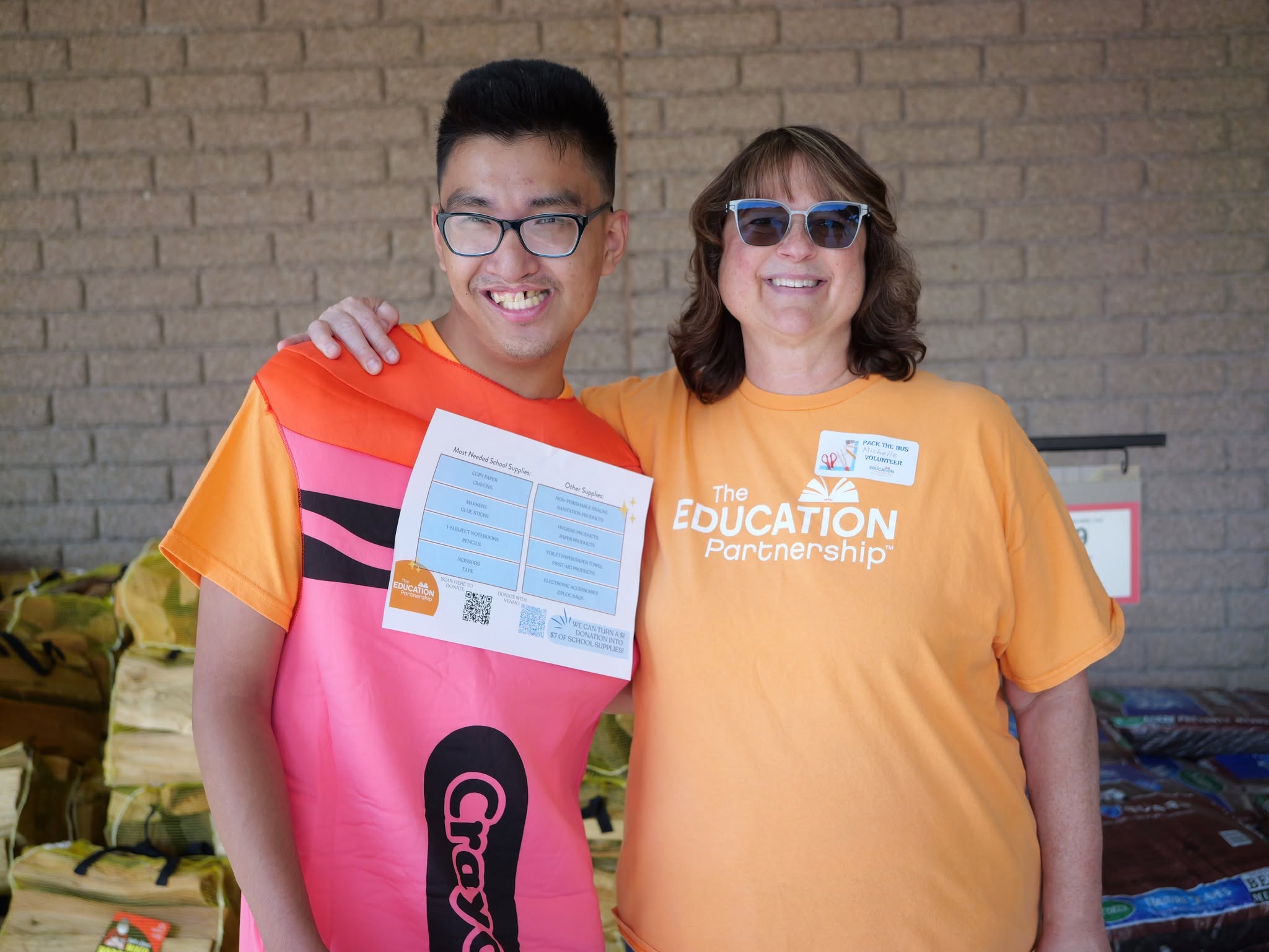
We recently sat down with Michelle Switala, a longtime member of TEP’s Volunteer Advisory Council, to talk about her classroom experience and why she keeps coming back to volunteer at The Education Partnership. Michelle has spent 31 years teaching at Pine Richland High School, where her students range from special education to AP Calculus BC, with just about everything in between (Pre-Algebra, Algebra 2, Physics) along the way. She’s been part of the Volunteer Advisory Council since 2022, and you’ll often find her volunteering on Saturdays during Teacher Shopping, as well as throughout the summer.
 What inspired you to get involved with TEP? Why did you choose to become a member of our volunteer advisory council?
One of my good friends is Lauren Hussar, Steve’s sister. Right after Steve got hired, Lauren shared that he’d just taken this great job [at TEP] and how proud she was of him. The work he is doing is really inspiring. I think the world of Steve. He’s a very committed, dedicated, gracious person. I said, ‘What can I do to help?’ He told me they’re just starting a Volunteer Advisory Council, so that’s how I initially got involved. I was one of the first members.
I also really like the other people on the advisory council, and I think the world of Adam, Deb, and Lisa. It’s just a good group of people.
Could you give me an example of a time that made an impact on you while volunteering?
I would say there are little things you don’t think about that you have access to in the classroom. For instance, I was volunteering in the Teacher Resource Center once, and a pallet of space heaters went out. You’d think people would have put out a pallet of gold bricks. It made me think people are teaching in cold rooms.
I think when I see teachers rifle through and look for socks, or it’s a coat drive. It’s not just about pencil and paper, although those things are important. It’s the other stuff that kids need to feel comfortable. If you are comfortable, warm, and fed, then you are better positioned to learn. I think TEP also steps in and fills that gap at least partly, as best we can.
You have been a teacher at Pine Richland for over 30 years, congratulations! In your experience, what are the biggest challenges that educators face?
So I think it might be a little bit different in a school like mine versus in a school like a lot of the clients at TEP. So my school is Upper Socioeconomic Status, so kids have a lot of advantages. Not everybody, but most do.
I think from the perspective of some of the clients at TEP, though, and I’m probably overgeneralizing here, but you’re just trying to make it through and get services when you don’t have easy access to resources, you don’t have extra money for things like tutoring, and so you’re just trying to get by. How do you equate the two? How do you offer equal opportunities and level the playing field? That’s where I think TEP steps in.
If someone was considering volunteering at TEP, what would you tell them?
I would say it is impossible to volunteer at TEP and not feel good about what you’re doing. It’s just such a feel-good place that you cannot help but see the good work that you’re doing. It’s like immediate, and it’s tangible. And as I said, I feel like it’s so necessary. And the staff is wonderful. You know, [the staff] does such a great job of making [volunteers] feel welcome. It’s a great place to volunteer.
Author: The TEP Team